$63,000. That is what Frankfurt Airport’s rainwater system cost in 1993, and for years that number sat wrong with me. Not because an airport spent it — an airport catches off 26,800 square meters of terminal roof and stores it in six basement tanks, and at that scale the arithmetic works. It sat wrong because of what I watched homeowners do with it. People would read about a system like that, or about the London Olympic Park cutting its potable demand by an estimated 73 percent, and conclude that catching rain was a project for engineers and budgets. Then they would do nothing at all, and keep watering a garden with treated well water they had paid to pump and pressurize.
How much rain does the roof catch?
Gallons caught = roof area (sq ft) × rain (inches) × 0.623.
One inch of rain on one square foot is 0.623 US gallons; the rest is arithmetic.
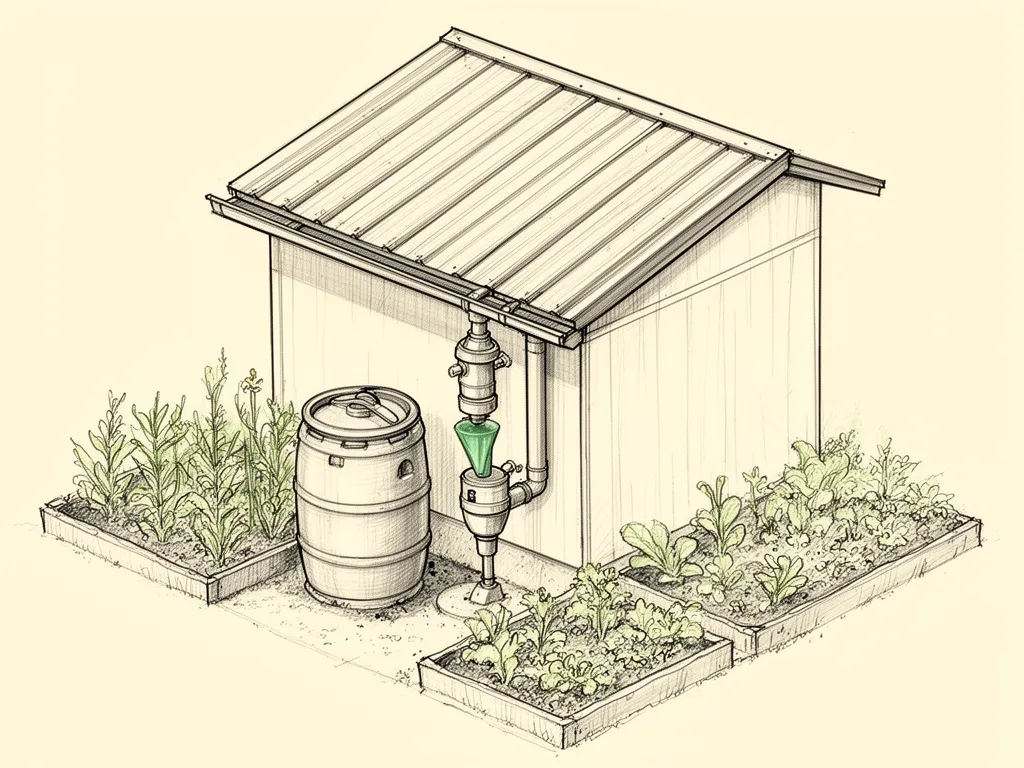
Rain catchment for non-potable use is not that project. It is a gutter, a screen, a diverter and a barrel, and it is one of the oldest water methods there is. Households in South Asia and elsewhere have run on it for thousands of years. The version on my shop roof is about as simple as the old ones, with one plastic part the ancients did not have.
The barrel under the shop gutter
At my place, the arrangement is a rain barrel fed by gravity from the roof of the shop. The shop roof is metal, which seems to matter — metal likely sheds water clean and fast, and in my experience it doesn’t seem to shed granules the way asphalt shingles do. The gutter runs to a downspout, the downspout runs to a first-flush diverter, and the diverter runs to the barrel.
The first-flush diverter is the part worth explaining. The diverter is a standpipe that fills first and holds that dirty water out of the barrel. Once the pipe is full, cleaner water flows past it into storage. You drain the diverter after the storm. That is the whole mechanism.
The barrel feeds the garden by gravity. No pump, no power, no pressure tank. A hose bib near the bottom, a short hose, and the water moves because the barrel sits higher than the beds. When the barrel is empty, the garden waits or I run a hose from the house, and I know exactly what that choice costs me in pumped well water.
The trade-off is capacity. A barrel is not a cistern. It goes dry in a stretch of no rain, and it overflows in a hard storm, and both of those are fine because the job it does — garden water — does not need to be there every single day. Match the storage to the job. The job here is keeping a garden through a normal dry spell, not supplying a household.
Water you do not drink
Keep the line between potable and non-potable sharp in your head and on your property. It has not been tested, it has not been treated, and it sits in a barrel at garden temperature. It is for the garden, for washing tools, for flushing if the well is down and you have carried a bucket to the toilet tank.
This is not a reason to avoid catchment. It is a reason to keep categories separate so nobody makes a mistake on a bad day. The barrel is marked. The hose that runs from it is not the hose anybody drinks from. The two 55-gallon drums in the garage are the household reserve — treated, dated, rotated twice a year, kept dark. Those are for drinking if the well goes down. The barrel is for tomatoes.
Test before you treat applies to the drinking side, not the barrel. The drums get checked when they rotate. The barrel gets nothing but a screen cleaned and a diverter drained. Do not spend treatment effort on water that is going into the ground around a squash plant.
The diverter that clogs
The maintenance is small and it is not optional. The screen at the gutter mouth catches leaves and it clogs. The diverter standpipe has a slow drain fitting at the bottom and it clogs slower, but it clogs.
The work is this. After a storm, drain the diverter. A few times a season, pull the screen and rinse it. Once a year, before the wet season starts, siphon the barrel down with the clean siphon hose, tip it, rinse the sediment off the bottom, and set it back. Headlamp on, bucket under the bib. Maybe an hour, once a year.
Skip it and the failure mode is not dramatic. The screen mats over, water sheets over the gutter instead of into it, and the barrel stays empty through the storm you were counting on. Or the diverter stops diverting and your barrel fills with first-flush water, and the garden gets whatever was on the roof. Neither failure announces itself. You find out when you open the bib and nothing comes, or when the water that comes is the water you meant to keep out.
The first season I ran the barrel, none of this was settled. The diverter was an experiment, the screen was whatever fit, and I checked the barrel the way you check a new thing — often, because it was new. The first few storms taught the sequence: the diverter filled, the barrel filled after it, the overflow went where I had pointed it, away from the shop footing.
By the second season the checking had settled into the routine it still is. The screen got pulled when the leaves said so, not on a schedule I had invented. The annual rinse moved to the week before the reliable rains, because that is when an empty, clean barrel is worth the most. Nothing about the hardware changed. What shifted across the seasons was that the setup quit being a project and turned into part of the property, just like the pressure gauge on the hose bib or the box of laboratory bottles near the rear entrance — something I look after without giving it much thought.
Over the years the barrel has covered most of the garden’s water in a normal year and some of it in a dry one. In a dry August, when Len’s shallow well on the next section runs low and mine is working harder than I like, every gallon the garden takes from the barrel is a gallon the well does not have to pump. That is the quiet arithmetic of non-potable catchment: it does not replace your supply, it takes a load off it.
Go watch the full video on household water storage before you set up anything bigger than a barrel — it walks the storage and treatment side step by step, which is where the mistakes that matter get made.
The myth, from firsthand experience: rain off a roof is clean because it fell from the sky. I have drained diverters after the first fall storm and poured out water you could not see through. I have also pulled clear water out of the barrel mid-storm after the diverter had done its work. The sky part is clean. The roof part is not.
The thing that went wrong at my place cost a barrel, most of one. One spring I set the barrel back after the annual rinse and did not seat the diverter connection properly — a small gap, easy to miss. The first good storm came through at night. The diverter filled, the joint leaked, and by morning most of a barrel’s worth of roof water was in the dirt against the shop footing instead of in the barrel. The fix was reseating and sealing a fitting. The cost was the water, a wet foundation corner I had to keep an eye on, and a reminder I still follow: after any work on the system, watch it through one full storm in daylight before you trust it. Water finds the mistake you made, and it finds it at two in the morning.
The counterargument I hear, and partly accept, is that in a dry climate catchment is a poor return — research on arid urban regions like the Middle East shows harvested water can be minimal in below-average precipitation years, and that is true here some years too. A barrel in a drought seems like an empty barrel. Where I push back is on the conclusion. The barrel is not the supply; it is a supplement that costs almost nothing to run and takes load off the well in the years it does rain. The failure mode of a supplement is that it gives you nothing some seasons. That is a known, acceptable failure mode. It is not a reason to have no supplement, and it is not a reason to skip the storage that actually carries you — the drums in the garage, which do not care whether it rained this month.
The steps I actually follow, in order, each year:
Check the gutter and clean the screen before the wet season.
Drain and rinse the barrel, check the diverter and every joint.
Watch one full storm in daylight before trusting the work.
Drain the diverter after each storm through the season.
Keep the barrel for the garden only, marked, hose separate.
Rotate the two garage drums twice a year and log the date.
That last item is the one that matters most and gets skipped most. The paper plan stuck on the inside of the pantry entrance lists what is located where and what to handle first, and my wife’s record shows when it was last checked and cycled. Catchment is a good supplement. Storage is the backbone.
Watch the full video now, before the wet season starts, and follow it through the storage and treatment steps in order.
Frankfurt’s six basement tanks hold 100 cubic meters under a terminal the size of a small town. My barrel holds what one shop roof gives it. Both systems work because somebody matched the catchment to the job, and the diverter on mine needs draining after tonight’s storm.