The first thing I see most mornings is the gauge on the pressure vessel in the utility room. It hangs off a tee by the well line, needle seeming to hold around fifty pounds unless something is wrong. Last October it seemed to bounce between twenty and sixty, fast, like a heartbeat. The pump was short cycling. The pressure tank had waterlogged over the summer and I had not caught it because the showers still ran fine. That morning cost me a service call on my own house, which is embarrassing for a man who has been paid for exactly that work for ten years. Water storage is the same kind of problem. Everything looks fine until the day you open a drum and smell it.
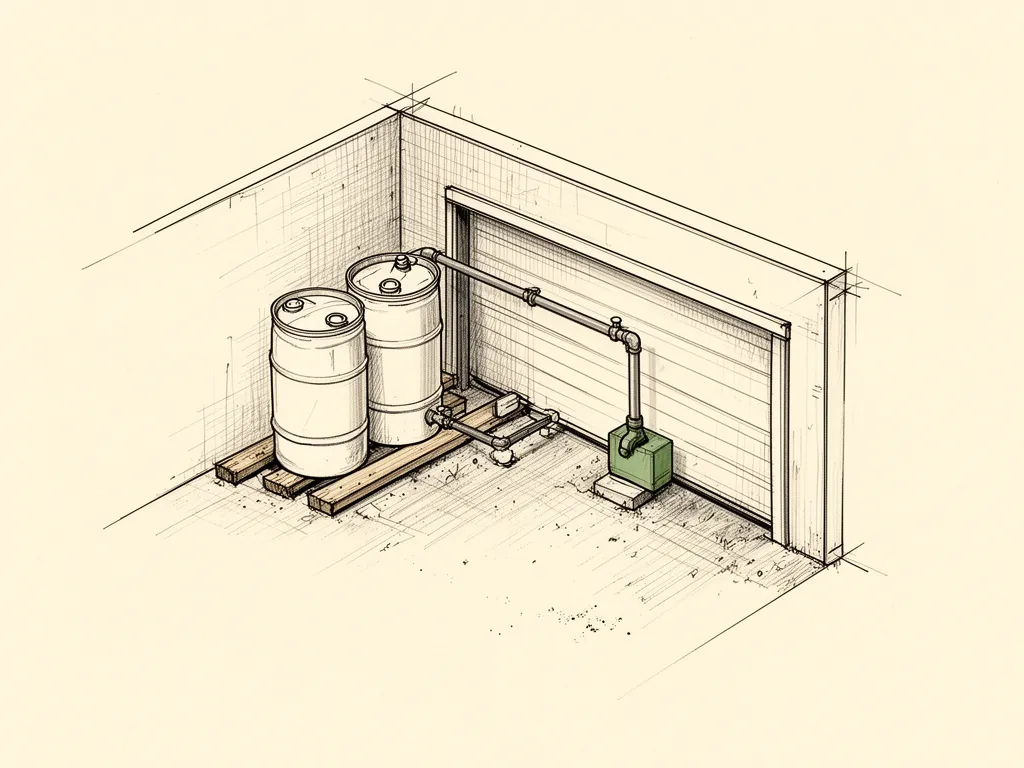
I keep a pair of 55-gallon food-grade barrels in the garage on the north wall, out of the sun. They are white plastic, the kind the feed store in town stacks by the door in spring. My wife keeps the log. It is a spiral notebook that lives in the pantry with the case of lab bottles and the test strips. Every entry is a date, a source, a strip reading and a note. She writes it down. I do the lifting. That division of labor has kept us honest for years because neither of us trusts the other to remember alone.
The rule in this house is simple. Storage beats gadgets. A drum you have tested and rotated is worth more than anything that promises to make water later. I have stood in too many pump houses where the owner shows me a filter still in the box and asks why the tap is dry.
Drums, rotation and the log
I filled them the first week of March this year, on a Saturday, off the well after the pressure tank fix had settled. City readers will ask why treat well water at all. The answer is that the well is clean now, and I want it clean in six months too. Test before you treat. The strips came back free chlorine at a trace, hardness high, pH where it always is here. The bacteria bottle went to the county lab on Monday and came back absent. Only then did I seal the bungs.
Rotation is twice a year, March and September, timed to the irrigation season. September water goes on the trees. March water goes on the trees. The drums empty through the clean siphon hose into buckets, the inside gets a wipe, and they refill the same day so the log never shows a gap. The trade-off is labor. You do not move them full. You siphon, tip, and roll them empty. If your back is bad, that is the failure mode to plan around, not contamination. Contamination you can prevent with a schedule. A hernia you cannot schedule.
Keep them dark and keep them off concrete if your garage sweats. Mine sit on wood runners. Neither condition is dangerous by itself. Both make people dump the water and quit, which is the real risk. Stored water that nobody will drink is not storage.
The bucket, the pump, the pantry door
The written plan is taped inside the pantry door in a sheet protector. It says where the drums are, where the siphon hangs, which breaker kills the well pump, and the phone number of the well driller, an old colleague from my county utility years. Under the shelf with the test strips sits a plastic bucket and a hand pump. That is the whole emergency kit. A bucket, a filter if you have one, and a plan. It covers most of what actually happens: a pump that dies on a holiday weekend, a power outage that runs past the pressure tank, a spring runoff that turns a well cloudy for a week.
I want to be plain about two options here, because I have run both in this garage. The first is the two 55-gallon drums I just described. The second is a single large tank, the kind that stands in the corner and seems like it could hold as much as a dozen drums in one footprint. A neighbor put one in three years ago and I helped him plumb it. The drums win on flexibility. You can siphon one, move one, take one in the truck to a family member. Their failure mode is the fittings. Bungs weep if you overtighten them, and cheap spigots crack. The big tank wins on labor. You fill it once and rotate with a valve at the bottom. Its failure mode is commitment. If the water in it goes off, you have lost everything at once, and draining that much water feels like an afternoon with a wet vac, not a bucket. My neighbor rotates his once a year instead of twice because of the volume, and last year he opened the valve in August and got a sulfur smell. He dumped the whole thing. That was the trade-off he chose when he chose one big vessel. Cost and upkeep cut both ways. I keep the drums.
Before you fill anything, though, before you even pick which container fits your garage, go watch the full video and follow it the whole way through, because the order of operations is the part people get wrong, and getting it wrong means you are storing a problem instead of water.
Marta lives on the next section over, on a shallow well that goes low every dry August. Two summers back she called me on the twelfth of that month and asked if she could run a hose. I drove over first to look. Her pressure gauge seemed to read twelve pounds and the pump was pulling air. “I have six gallons in the fridge,” she said. I asked her what her plan was. She said, “This is the plan. I call you.” I told her that was a plan with one step and a single point of failure, and she laughed, and then we ran the hose from my drums and she came back the next weekend with her husband to look at her setup. The line she kept repeating all that fall was, “I just never thought about the water after the tap.” Most people do not. That is not a criticism. It is what twenty years of the tap working does to a person.
What I would tell a friend who asked me where to start is about this: start with the log, not the container. Write down your source, test it, and only then decide how much to store. I’d guess two drums would be my answer for two people. A family of five needs more, and the range varies by site, so I will not hand you a number. But I would say this verbatim: “If you can’t tell me the last time your water was tested, don’t store it yet. Find out what’s in it first. The water is the easy part. The schedule is the part that saves you.”
Here is the worked example, from the service call I keep coming back to because it taught me more than any other. March 2019, a household of four on a drilled well outside town. Their well had been fine for twenty years. After the spring runoff that month the tap ran slightly cloudy and they called. While the system sat treated, the family needed water. They had none stored. I brought them one of my drums and a siphon, and they ran the house on it for the week: cooking, coffee, sponge baths, toilet flushing with buckets from the rain barrel I happened to have full. They kept count on the drum with a grease pencil. The mother wrote the tally. When I picked the drum up it was dated and marked, and she asked where to get two of her own. That family has rotated twice a year since. The log my wife keeps now has their names in it because we trade reminder calls every March and September.
Now the thing that went wrong, because it did, and it cost. In September 2021 I rotated on the wrong weekend. We had company, I pushed it off three weeks, and in that gap the September heat held and the garage hit temperatures it usually does not see that late. When I opened the first drum the water was fine chemically but it smelled stale, flat and warm, and my wife would not drink it, and she was right. The cost was a day of work, one drum’s worth of treated water, and a mark in the log that still bothers me when I see it. The lesson was not that storage fails. It was that the schedule is the system. The water in the drum is only as good as the date next to it.
People ask about bigger solutions sometimes. A man at the feed store last spring wanted to talk about whole-property systems, pumps with backup power, the works. A household needs water that is already in the building. Storage beats gadgets, at every scale, and the cheapest reliable option wins. Extraordinary assertions need a spec sheet, and most spec sheets, when you read them, point you back to a barrel and a logbook.
So before you rotate your next drum or fill your first one, sit down and watch the full video now, and then go touch the equipment yourself, because reading and watching get you to the garage door and the work starts inside it.
Test it, store it, write the date down, rotate it. That is the whole thing.