A neighbour down the county road asked me last month why his taps sputtered after the power came back on. He thought the pump was done. It was not. The pressure switch had a burned contact and the tank had lost its air charge years ago. Two small parts, both cheap, both overlooked because nobody had ever walked him through what lives down there. That is most well trouble I see. Not catastrophe. Neglect of parts you cannot see.
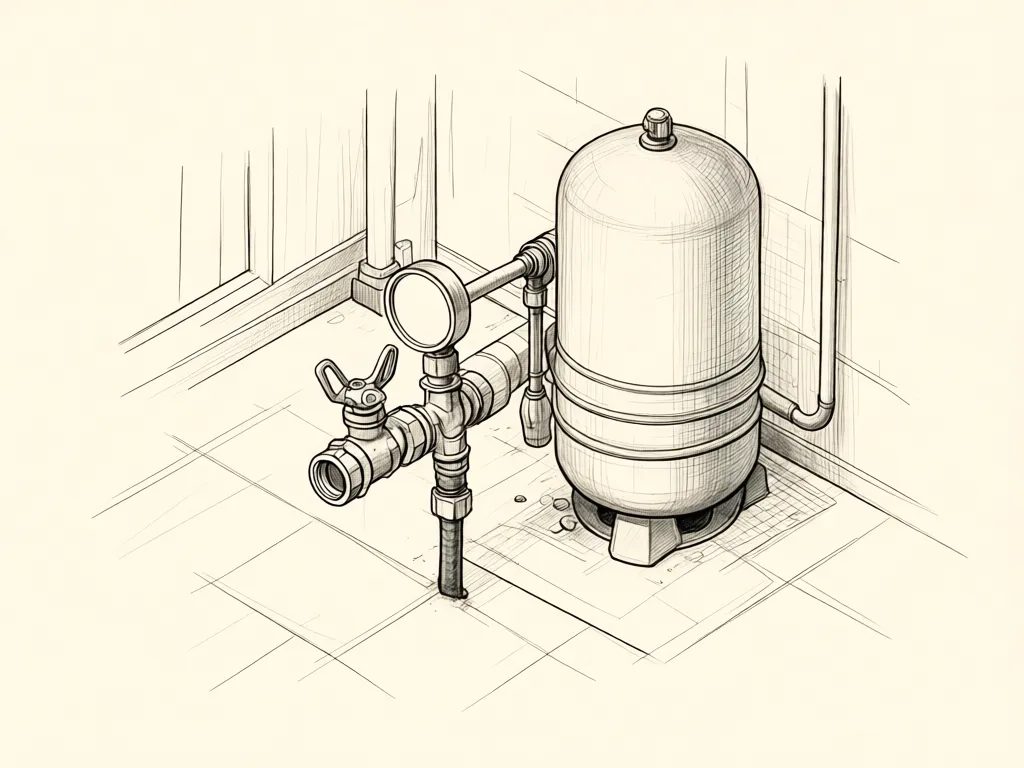
The pump that sits in the dark
A drilled well in this country usually runs a submersible pump. It sits down the casing, underwater, and seems to push water up the drop pipe rather than pulling it. That matters because, in my experience, a submersible seems far less prone to losing prime than an old jet pump. It either runs or it does not.
The trade-off is access. When it fails, you are pulling pipe. On my own well the pump hangs on the drop pipe and the only way to inspect it is to winch the whole string up. You do not do that for fun. So the first rule of pump ownership is to stop guessing. Check everything above ground first. Nine calls out of ten, the fault is in the wiring, the switch, or the control box, all of which you can reach standing up.
A submersible that cycles on and off fast seems to be dying early even while it still works. That rapid cycling is almost never the pump’s fault. It is the tank or the switch making the pump start and stop dozens of times an hour, and every start is a hammer on the motor. The pump is the expensive part. Protect it by minding the cheap parts.
The tank that is mostly air
The pressure tank in your utility room is not a water tank. It seems like an air cushion with water on one side of a diaphragm. The air compresses, the water pushes back, and that is what lets your pump rest between cycles.
You can hear it: click, click, click, a few seconds apart. The fix costs almost nothing if you catch it. You drain the tank, check the air charge with a gauge, and, in my experience, set it a bit below the switch cut-in. If the tank will not hold air, I’d guess the diaphragm is gone and the tank is done, and no amount of topping up will save it.
I keep a hose-bib-mounted pressure gauge for exactly this. Static pressure tells you what the system holds. Watching the needle while a tap runs tells you where the switch cuts in and out. A pressure switch is a wear item. The electrical contacts on it tend to erode and oxidize with age, and once they fuse or degrade the pump fails to turn on or shut off. Replacing the switch is an afternoon job with the power off and the breaker locked.
People say the pump just wears out with age. Sometimes it does. What I see more often is a pump murdered by a waterlogged tank and a burned switch, both of which were announcing themselves for a year. The sound of rapid cycling is the sound of money leaving. The myth is that wells fail suddenly. In my experience they fail slowly and loudly, and nobody listens.
The full walk-through of checking a tank charge, reading a switch, and setting the system back up is easier to follow on screen than on the page. Pull up the video and follow it step by step with your own gauge in hand: open the full video.
If a friend asked me where to start with a new-to-them well, I would say what I told the fellow at the feed store last week. Learn where your pressure switch is and what it sounds like when it clicks. Learn where your tank’s air valve is. Learn where your breaker is. Those three things will carry you through most of what goes wrong. Write down the static pressure and the cut-in and cut-out once a year. When the numbers drift, something changed, and you want to know before the pump does.
On a service call in April, out past the feed store on the next section, the complaint was no water on a Sunday morning. The well was fourteen years old, drilled to a depth the owner could not remember, with a submersible and a tank in the garage. Static pressure at the hose bib read zero. The breaker was on. The control box hummed, which told me the capacitor was trying. The pressure switch contacts were blackened and one was welded shut. I swapped the switch, drained the tank, and found the air charge at zero with water at the air valve, which told me the diaphragm had failed. The tank would not hold pressure. The owner had a spare switch on the shelf from a previous visit and the tank took the rest of the afternoon. By evening the system held steady at its normal range and the pump cycled the way it should, long runs and long rests. The parts were not the story. The story was that the tank had been waterlogged for at least a year and the switch had been arcing for months, and both had been audible if you knew the sound.
Two ways people handle the air-charge question, and I have done both. The first is to check the charge on a schedule, once a year, with the tank drained and a gauge on the valve. It takes half an hour and costs nothing. The second is to wait for the symptom, the rapid clicking, and fix it then. I ran the second way for years on my own place because I was busy and the pump seemed fine. The pump seemed fine until the start winding got hot enough that the motor’s life shortened, and I paid for my laziness in pulling pipe. Now I do it the first way, on a date my wife writes in the household log next to the drum rotations. The scheduled check wins because the failure mode of the reactive way is hidden until it is expensive.
There is a fair argument the other way. I partly accept that. If you are not comfortable killing a breaker and proving it dead, do not open the box. That is a real risk and I will not talk anyone past it. But the argument goes too far when it says you should not even look. Listening costs nothing. Reading a gauge costs nothing. Writing down three numbers once a year costs nothing. The line I draw is between observing, which every well owner should do, and wrenching, which you should do only within your own competence. A service call you never needed is cheaper than a pump you killed, but a service call that finds a ten-minute problem you could have seen coming is money spent on not paying attention.
The other piece people overcomplicate is what happens to the water between the pump and the tap. On my place the system is simple: the submersible, the drop pipe, the pitless adapter through the casing, the line to the utility room, the switch, the tank, and out to the house. Every fitting is a place for a leak and every valve is a place to isolate a section when one fails. Know your main shutoff. Know how to drain the system. If you ever need to shock a well after a bad bacteria test, and spring runoff gives me one of those every few years, you will need to know how the water moves and where it sits. Test before you treat, always. Ray’s shallow well goes low every dry August, and the year he tested after runoff he was glad the bottle was already by the back door.
Storage sits on top of all this as the buffer for the day the pump does quit. My two drums in the garage, kept dark and rotated twice a year, are not a lifestyle. They are eight days of not panicking while the driller fits me into his schedule. The bucket, the hand pump and the plan in the pantry cover the gap between the drums and the day the parts arrive. None of this is exotic. All of it depends on understanding the mechanical system underneath it, which is why the parts matter more than the storage.
The full job, from checking a switch to setting a tank charge to laying out your storage and testing routine, is worth seeing done in order with real hands on real fittings. Open the video and follow it step by step while you work through your own system: play the full video.
The gauge I use has a crack across its face from the time I dropped it off the tailgate onto gravel. It still reads true. I checked it against the new one and kept the old one anyway, which says something about me I do not care to examine.